
· Dane Whitlock
Espresso station or a simple knock box: what your counter actually needs
An espresso station bundles a tamping pad, a tamper cradle and a knock bay into one fixed tray. A knock box does one job, and moves. The two questions that decide it are where you tamp and how the grounds come out: a bay you cannot lift is emptied differently from a body you carry to the tap.
Both formats put a rubber bar between your portafilter and something hard, so this is never a question of whether to catch the puck. It is a question of how much furniture comes attached to the part that catches it. What follows is what changes when the knock box is a bay inside a tray rather than a body of its own — the depth it is allowed to have, how it empties, what a fixed bar does to the strike, and how the counter is paid for on the mornings you use one function out of four. If you are still working out what the tool replaces, start with what a knock box is and come back.
What an espresso station actually bundles
The category goes by several names — tamping station, espresso station, barista station — and the contents are broadly the same. A flat pad of silicone or rubber to tamp on. A cradle or a post that holds the tamper upright. A rest for the portafilter while you dose. And a knock bay with a bar across it. Some add a slot for spare baskets or a distributor.
The organising idea is a good one: the four things you touch between grinding and locking in should sit within one hand's reach of each other, on one object, in one place. That is why the format sells, and the logic is not in dispute here.
What it also means is that four parts are dimensioned together rather than separately, and they do not want the same dimensions. A tamping pad wants to be flat, wide and at knuckle height. A portafilter rest wants to be shallow. A knock bay wants to be deep. When they share a frame, the deep one is the part that gives way, because a tray tall enough to hold a morning of pucks is no longer a tray you can comfortably press down on — you would be tamping at chest height.
So the compromise is nearly always made in the same place. It is made in the knock bay, and it arrives already made, built into the geometry of the frame.
The knock bay is a compartment, not a body
Depth is the property that decides how often you empty anything, and it is the property a shared frame has the least of to give. A knock box is a body with a volume, and the volume is the entire point of it: ours holds 700 ml (24 fl oz), which one buyer described as about right for ten cups. A bay built into a level tray has the depth the tray can afford, which is roughly the depth of the tamping surface beside it plus whatever the feet add underneath.
That is not a complaint about any particular product. It is what happens when a container has to share a top surface with a work surface. The pucks stack into a smaller volume, so the interval between emptying gets shorter — and the interval is what decides whether a routine survives a weekday morning or quietly stops.
There is a second consequence, and it shows up at the mouth. A dedicated box can be cut on an angle, so the opening presents itself to the portafilter as the rim comes down and your forearm lands square without correcting for it. A bay set into a flat tray usually presents a level rim, because the top of the tray is a plane and the tamping pad has to sit in that plane. A level rim asks you to aim, every morning, on a tool you use before your first coffee.
What a fixed bar changes about the strike
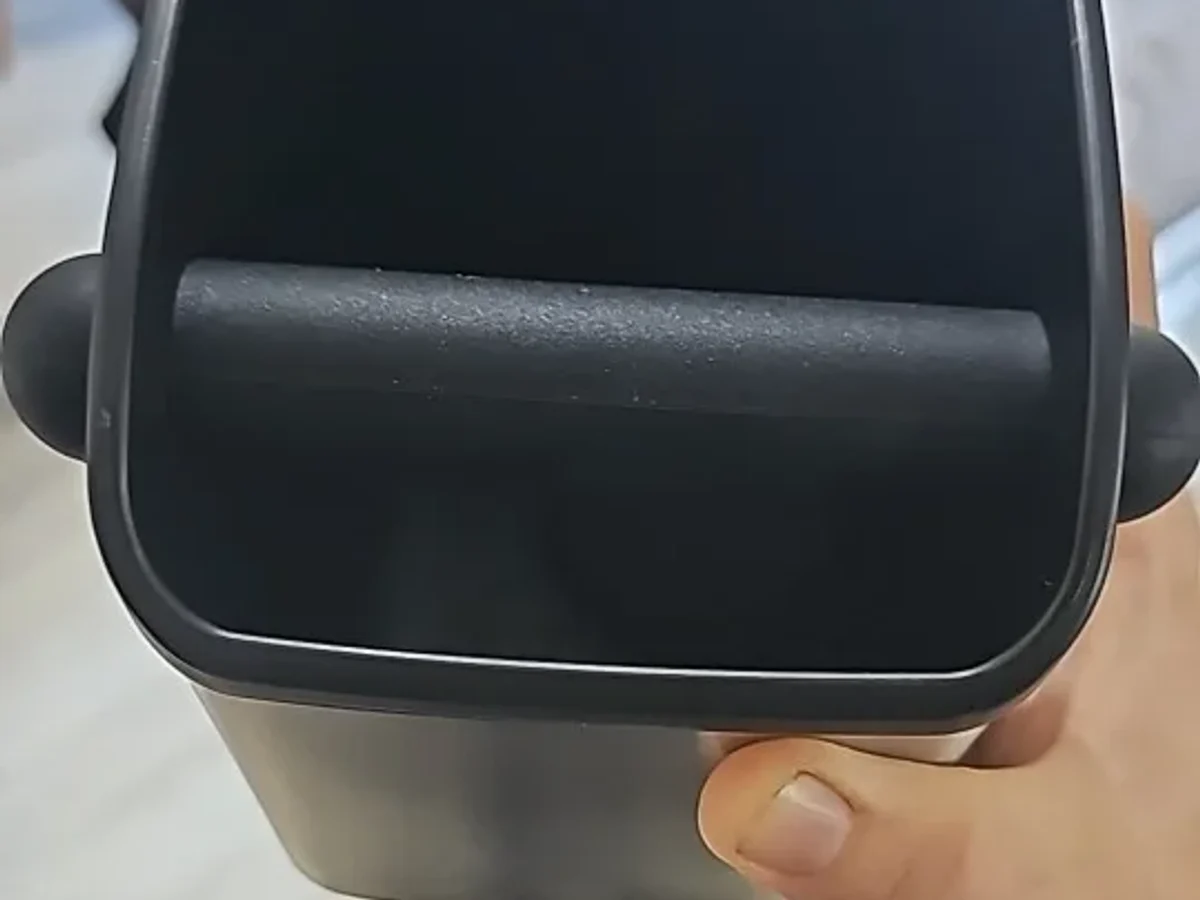
The bar is the part that does the work, and there are two things to want from it: rubber over a rigid core, so it gives under the rim without ever letting the rim reach anything hard, and the ability to lift out.
In a station the bar is generally a crossbar moulded or bolted into the frame. Under a firm strike, a bar anchored into a wide rigid frame tends to behave the way a bar behaves when you strike it near its mounts rather than across its span: the give is backed almost immediately by structure, so the impact comes out shorter and harder. The gesture itself does not change between the two formats — hold the handle, bring the rim down square, knock once firmly — and it is set out in full in how to use a knock box.
What changes is the margin the tool leaves you on the mornings the strike is not perfect. The rim of a portafilter basket is a machined edge that has to seal against the group head gasket while water is forced through the coffee at around nine bars, and the entire reason a bar exists is to be the softer of the two surfaces, every day, for years. That is why the bar on the Barwright box is rubber over a rigid core, and why it lifts out.
Emptying, and the difference you meet every morning
This is the part that decides whether either object is still on the counter in a month.
Emptying a knock box is one movement. Lift the bar out, pick the body up, tip it into compost or the bin, rinse it under hot water, put the bar back. Ten seconds, one hand, at a tap you are already standing beside.
Emptying a knock bay that is part of a tray means one of two things. Either you tip the whole tray — with the pad, the tamper and everything else it carries — over a bin, which means unloading it first. Or you lift out an inner cup, which only exists on the designs built with a removable liner. That is a detail to confirm rather than to assume, because from the photographs the two look identical.
Rinsing splits the same way. A body goes under a tap. A tray made of a silicone pad, a frame and a knock bay does not go under a tap as an assembly, so the wet part gets wiped rather than rinsed. The seat the bar sits in is exactly where fine grounds collect out of sight, and it is the first part of any design to smell — which is why the daily routine in how to clean a knock box begins there rather than with the body.
A reserved rectangle, or an object that moves
A station holds its footprint permanently, and that is not a flaw — it is the function. Everything has a place, so the places have to be there whether they are occupied or not. The rectangle is reserved at ten in the morning while you are chopping beside it, and at eight at night when nobody has pulled a shot for hours.
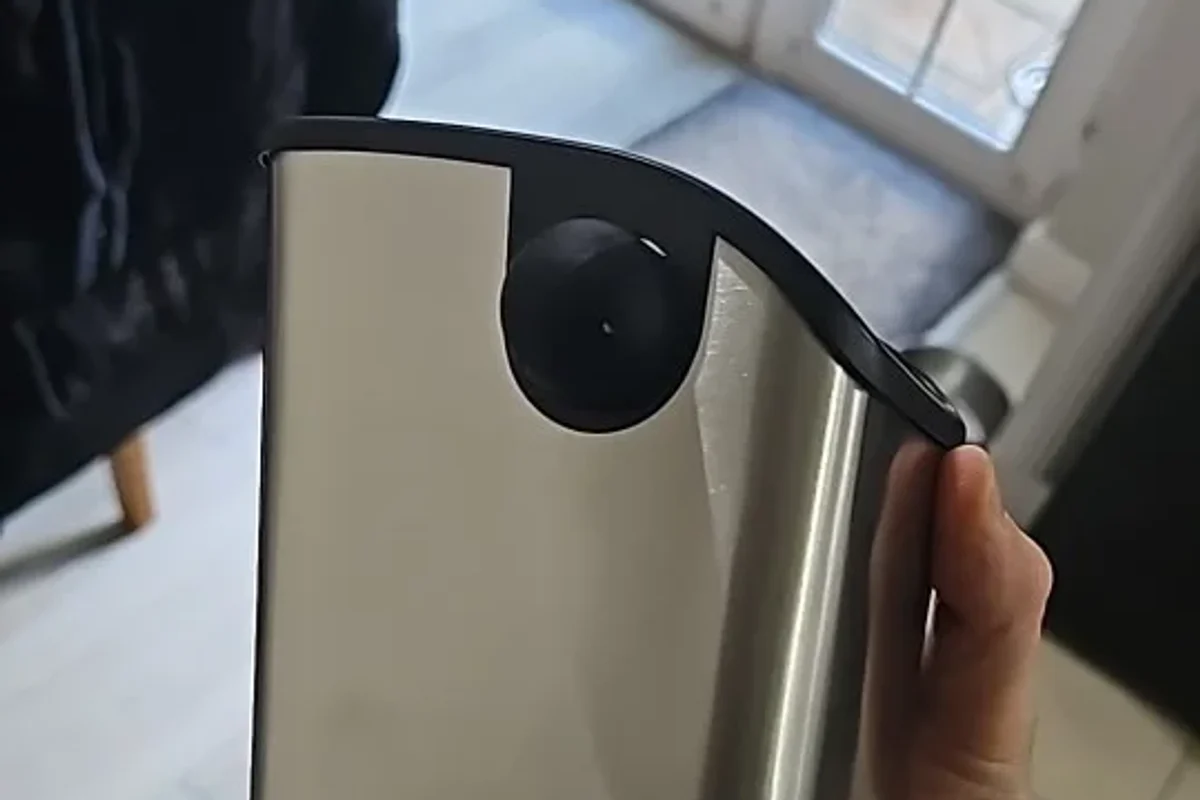
A knock box is a single object, so it moves. It stands beside the machine while you are making coffee and goes to the back of the counter when you are not. It travels, too: the same body works at a second machine, in an office kitchen, or wherever the machine ends up after the next reorganisation. Ours sits beside the machine rather than under it, which is what makes that possible.
So the counter question is not really about area. Two objects with the same footprint are not equivalent if one of them can be picked up with one hand, and the difference between them is commitment rather than centimetres. The specific placements that work when the counter is full — and the one that quietly fails — are laid out in where to put a knock box when the counter is full. The prior question, and the one that belongs here, is whether the space you hand over is handed over once or handed over for good.
How many of the bays you use before your first coffee
The tamping pad is the part that justifies the format, and whether it justifies anything comes down to a single habit: where you tamp.
If you tamp on the counter, standing over the portafilter, then a pad, a cradle and a knock bay on one object is a genuinely coherent set. You will touch three of the four every morning, and they will be where you left them.
If you tamp at the grinder, in your hand, on a folded cloth, or with a tamper that lives in a drawer — or if your setup puts the tamper at the grinder chute — then the pad and the cradle are surfaces you wipe around. What you use daily is the knock bay, which is the one part the format had to compromise in order to fit.
That calculation is settled by watching yourself make one coffee, not by reading a specification. Count the bays your hands actually touch between grinding and locking in. If the answer is one, then a tray is the packaging and the bay is the purchase. Our four criteria for the bay itself — the bar, the base, the body and the capacity — are set out on how to choose a knock box, and they apply whichever format it arrives in. The machine matters more than the accessories around it, too: whether the bar sits at the height your portafilter reaches, and whether the mouth is wider than your basket, is the subject of knock boxes and espresso machines.
Where a station genuinely wins
Two places, and both of them are real.
The first is the tamper. A tamper is a heavy metal object with a flat polished face and a habit of lying on its side in whatever is wet. A cradle that keeps it upright, in one known position, beside the point where it is used, solves a small daily irritation completely and permanently.
The second is a counter with depth to spare and a layout that is settled — a machine that is not moving, a kitchen that is not being rearranged, and a strip behind the machine that nothing else has a claim on. Under those conditions a reserved rectangle costs nothing, because nothing else wanted the space.
What neither of those changes is the bay. The bar you strike, the depth you fill and the seat you rinse are the same three things to check, and they are the three the shared frame trades away first.
What we ended up building
We built the bay as its own object, because the properties that decide a knock box are exactly the ones a shared frame has to give up.
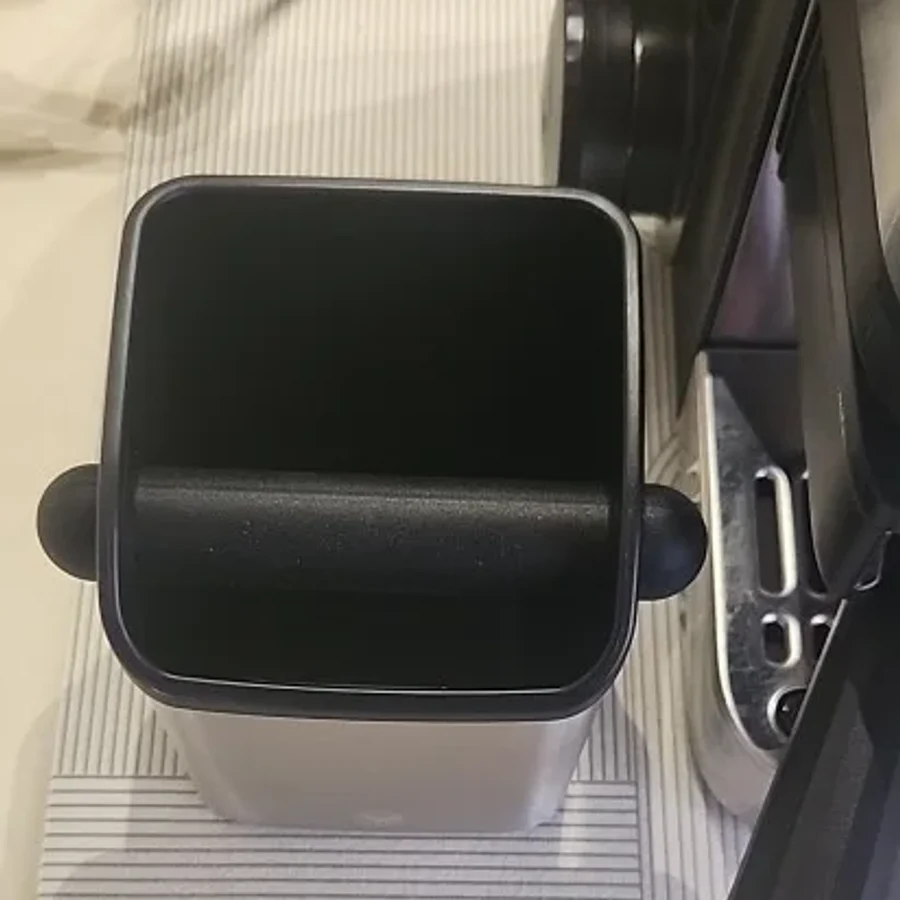
A brushed stainless steel body, so that a year of coffee oil, hot metal and daily rinsing leaves it where it started — the material argument in full is on our stainless steel page. A 700 ml (24 fl oz) volume, so a morning of shots fits without an interruption partway through. An angled mouth, so the arc of your forearm lands square without aiming. A knock bar that is rubber over a rigid core and lifts out in one movement, so the ten-second rinse is something that actually happens daily. And a non-slip base with enough mass under it that the box stays where you put it, which is what keeps your free hand out from under a descending rim.
Espresso machines now reach 12% of US households, up from 8%, and 43% of American adults drank an espresso-based beverage in the past week (National Coffee Association, National Coffee Data Trends, 2025). Almost all of those counters were laid out before the machine arrived on them. A tool that does one job properly, and that can be lifted with one hand when the counter is needed for something else, is the easier thing to fit into a kitchen that is already full.

Dane Whitlock · Founder, Barwright
Fifteen years behind bars and in equipment service, most of it spent repairing the machines other people knocked their portafilters against.