
· Dane Whitlock
How to use a knock box: the grip, the angle, and one firm knock
Hold the portafilter by its handle, bring the rim down so it meets the bar at a right angle, and knock once — firmly. The puck drops out whole. Strike the middle of the bar rather than its ends, keep your free hand off the box, and empty it every morning.
That is the whole technique. What follows is the reasoning underneath each part of it, because the details that look cosmetic — which hand goes where, which part of the bar takes the blow, how long you wait after the shot — are the ones that decide whether your basket still seals cleanly in a year. If you are still working out what the tool replaces, start with what a knock box is and come back.
Hold the handle, and leave your other hand out of it
The grip is the part nobody thinks about, and it is the one that sets everything else. Take the portafilter by the handle, the same way you carry it from the group head, with your hand well back from the metal. Your wrist stays loose. The strike comes from a short drop of the forearm, not from a flick of the wrist and not from the shoulder.
The instinct almost everyone has on their first morning is to steady the box with the other hand. It is worth resisting, for two reasons. The first is that it puts your knuckles directly beneath a metal rim travelling downwards, which is a poor arrangement. The second is that a box you have to hold is a box that would otherwise be moving, and a box that moves absorbs the energy you meant to put into the puck.
A body with real mass and a non-slip base underneath removes the question entirely: the box stays where you put it, so both the strike and your spare hand are free. That is the whole argument for weight, and it is why we treat the base as a first-order criterion rather than a finish detail on how to choose a knock box.
Bring the rim down square to the bar
Square means the plane of the basket rim and the line of the bar meet at roughly a right angle — the rim comes down onto the bar, rather than skidding across it.
Angle is what separates a knock that works from one that scatters. Come in tilted and two things happen at once: part of the impact turns into a sideways push, which is what sends a light box travelling across the counter, and the puck leaves the basket on a diagonal, which is how grounds end up on the counter beside a box that was perfectly well placed. Nobody misses the box because it is too small. They miss it because the rim was not square when it landed.
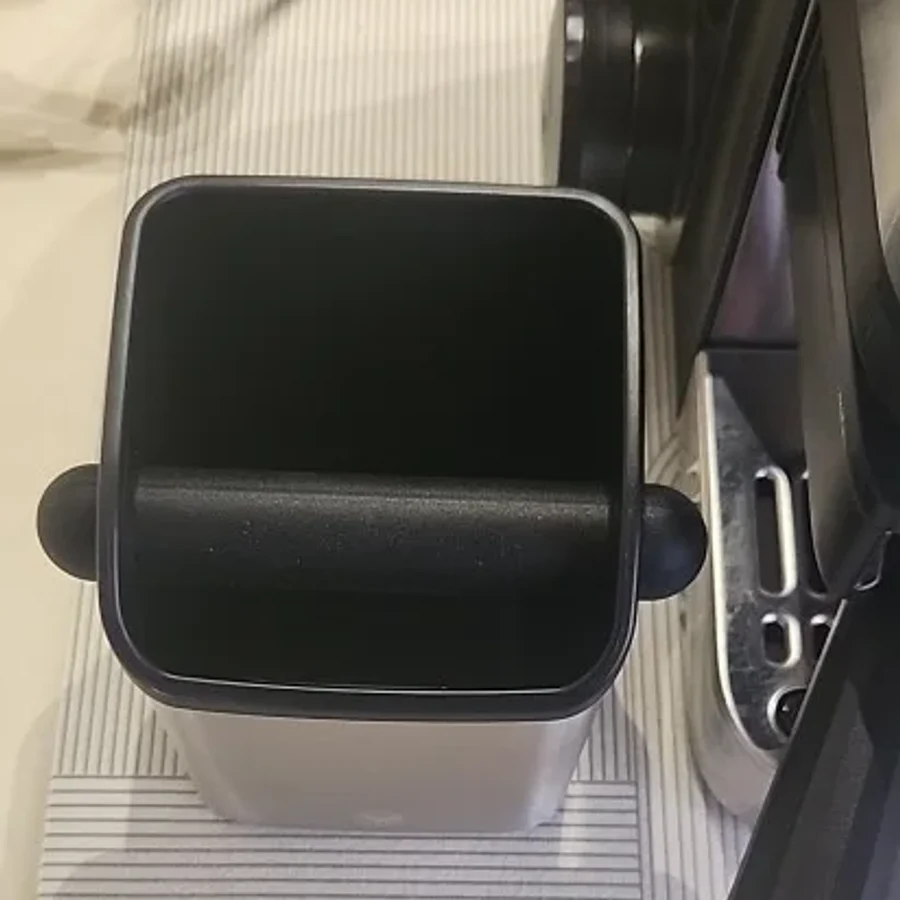
This is where the shape of the opening quietly does some of the work for you. A mouth cut on an angle presents itself to the portafilter as it comes down, so the natural arc of your forearm already lands square without you correcting for it. A straight-cut top asks you to aim, every morning, on a tool you use before your first coffee. It is a small piece of geometry with a daily payoff.
Strike the middle of the bar, not the ends
The bar spans the opening and is anchored at both ends. The middle is the span; the ends are the mounts.
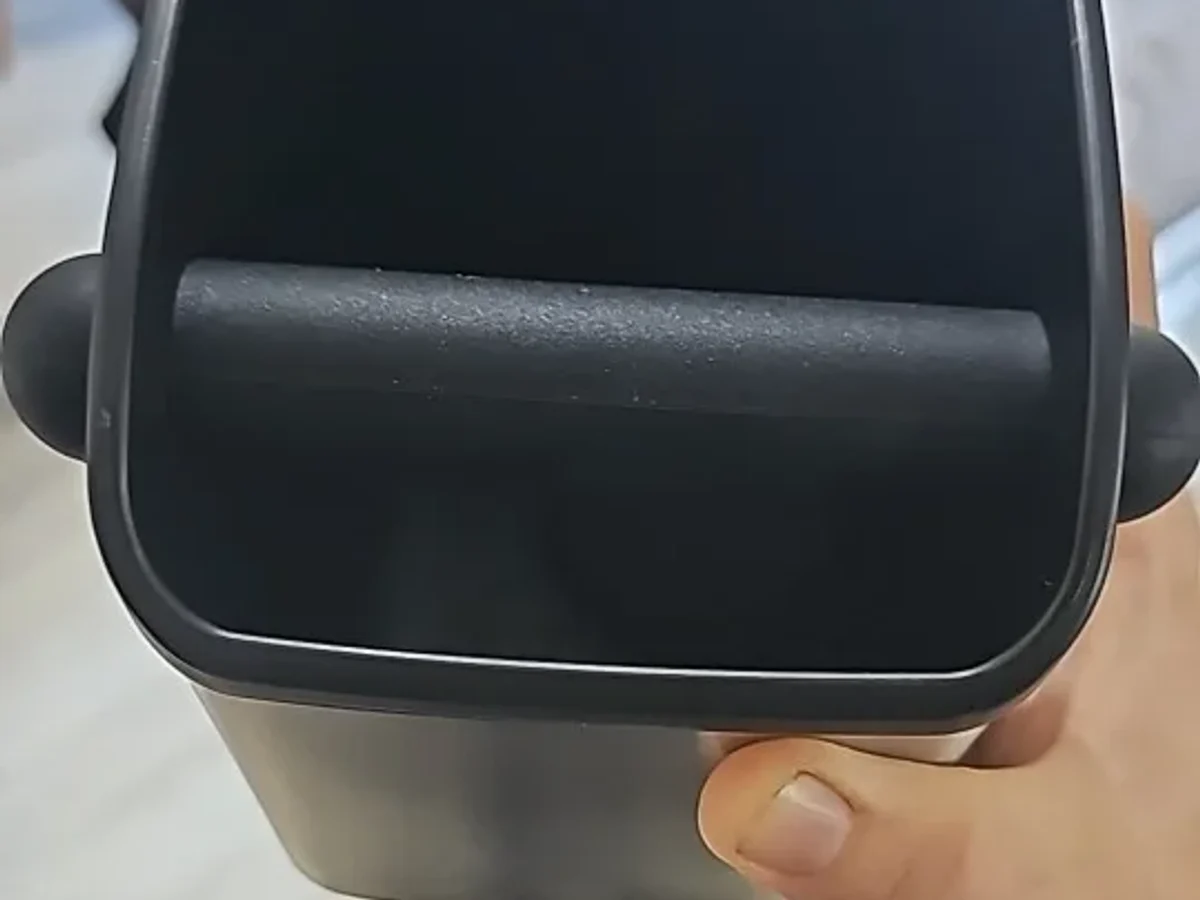
Aim for the middle third. A bar is rubber over a rigid core, and across its free span that rubber has room to deflect under the rim — that give is what makes the impact firm on the puck and gentle on the metal. Strike close to a mount and you get much less of it, because the rubber there is backed almost immediately by the fixing. The blow becomes harder and shorter, which is exactly the character of impact you bought the box to avoid.
There is a second reason, and it is about where the puck lands. Hit the centre and it drops straight down into the body; hit near an end and it tends to leave the basket at an angle, catching the rim of the opening on its way.
One firm knock beats three careful ones
Water is forced through the coffee at around nine bars, and the 15 to 20 grams left in the basket come out compressed hard and gripping the walls. The puck is not sitting in the basket. It is wedged into it.
So the force has to be genuine. One firm knock, from a short controlled drop of the forearm, and the whole puck releases in a single piece. What goes wrong is almost never knocking too hard — it is knocking as though the machine might break, which leaves a ring of grounds bonded to the basket wall and sends people looking for a spoon or a fingernail to finish the job. Both of those mark a basket far more than any knock ever will.
If the puck does not release on the first strike, the answer is one slightly firmer knock, not a series of taps. Repeated soft blows deliver too little to break the seal between coffee and steel, and you end up striking the rim four times instead of once. Fewer, better-committed knocks put less total work through the metal.
Calibrating it is quick, and you do it by looking rather than by counting. Knock, check the basket, adjust. Once the walls come away clean with a single strike, that is your force, and you will not have to think about it again.
What actually marks a basket
The rim of a portafilter basket is machined to sit flush against the group head gasket, and that fit is what holds pressure while the shot pulls. Three things put it at risk, and the knock itself is not among them when there is rubber to meet.
The first is a hard, unforgiving edge — a bin rim, a countertop lip, the side of a sink. Metal against metal deforms the softer of the two, one morning at a time, and the symptom arrives much later as a shot that sprays sideways past the gasket.
The second is metal cutlery. A teaspoon used to lever out a stubborn puck scores the wall of the basket, and a scored wall holds grounds and oil in the scratch where no rinse reaches. The third is levering with a fingernail against the rim, which is the same problem with less leverage and more mess.
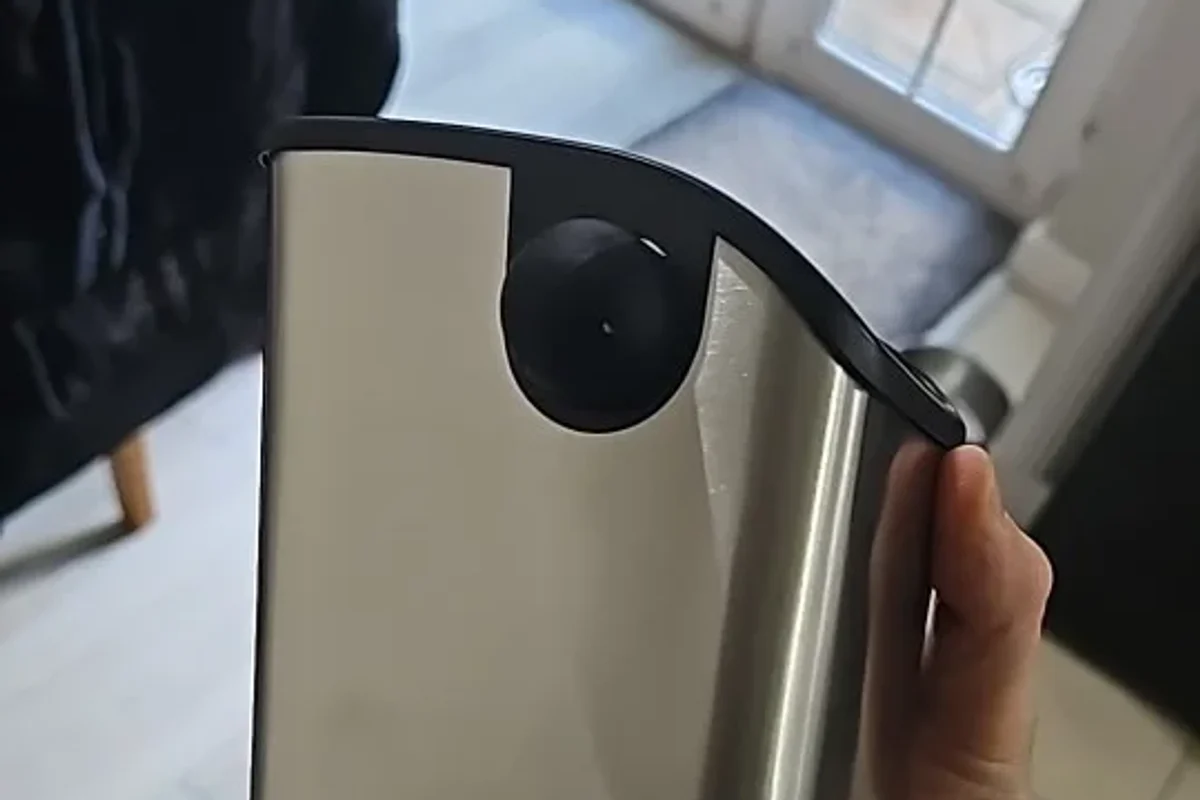
All three are solved by the same thing: a strike that releases the puck whole, first time, against a surface designed to give. That is the entire job of the bar — and it is why the bar on the Barwright box is rubber over a rigid core, and lifts out.
The rhythm when you are pulling two shots
Back-to-back shots are where a good routine earns its keep, and the ordering is worth getting right because the puck changes as it sits.
Knock straight after the shot, while the puck is still hot and damp. In that state it holds together and leaves the basket as one disc. Leave the portafilter locked in the group head while you steam or drink, and the puck cools and tightens against the walls as it dries; it then comes out in fragments and takes two knocks instead of one.
The sequence that flows best is short: unlock, knock, wipe the basket with a dry cloth, purge the group head, re-dose. Knocking first means the basket is empty by the time you are ready to grind, and wiping immediately after takes the last film of coffee off while it is still warm and loose.
Between two shots there is no reason to empty the box. A 700 ml (24 fl oz) body holds a full morning without needing attention — one buyer described it as about right for ten cups.
Emptying it, and when
Once a day, in the morning, while you are already standing at the machine. That is a decision made once and then never again, which is the only kind of routine that survives a weekday.
The motion is the same each time: lift the bar out, tip the contents into compost, onto a garden bed or into the bin, rinse both under hot water, put the bar back. It takes about ten seconds when the bar detaches. Whether it detaches is the single design detail that decides if this actually happens daily or drifts to weekly, because the underside of the bar and the seat it sits in are where fine grounds collect out of sight.
Two things not to do with the contents. Do not tip them into the sink on the way past — coffee grounds do not dissolve, they bind with the grease already in the pipe and set in the trap, the mechanism laid out in why coffee grounds block drains. And do not let the box become storage: spent grounds come out warm and wet, and warm wet coffee ferments in any container in any material. The deeper routine, including the wash every few weeks, is in how to clean a knock box; the choices for the grounds themselves are in what to do with used coffee grounds.
When the knock does not come out clean
Almost every complaint about the motion traces back to one of five causes, and all five are adjustments to the gesture rather than problems with the coffee.
| What you see | What it usually is | What to change |
|---|---|---|
| A ring of grounds welded to the basket wall | The strike was too tentative to break the seal | One firmer knock, not three soft ones |
| Grounds land outside the box | The rim came down tilted rather than square | Drop the forearm straight; let the angled mouth present itself |
| The box shifts on the counter | Part of the blow is going sideways | Strike downward, and check the box sits on a dry surface |
| The puck breaks into fragments | It cooled and dried in the basket before you knocked | Knock right after the shot, while it is warm |
| You are striking two or three times | You are aiming near a mount instead of the span | Move the contact point to the middle third of the bar |
A soupy puck that will not hold together is the one entry on that list that is not about the knock — it is a dose and grind question, and it comes out of the basket the same way regardless. Knock it out, wipe the basket, carry on.
Why more kitchens are learning this now
Espresso machines reach 12% of US households, up from 8%, and 71% of past-day coffee drinkers make their coffee at home only, up from 63% in 2020 (National Coffee Association, National Coffee Data Trends, 2025). That is a large number of people who learned to pull a shot from a video and were never shown what to do with the thing left in the basket afterwards.
The motion takes two seconds and, done the same way every morning, it protects the one component that seals your machine against nine bars of pressure. Give the puck somewhere designed to receive it, put it there squarely and once, and the rest takes care of itself — including where the box should live, covered in where to put a knock box when the counter is full.

Dane Whitlock · Founder, Barwright
Fifteen years behind bars and in equipment service, most of it spent repairing the machines other people knocked their portafilters against.